Showing posts with label high-speed rail. Show all posts

Thursday, February 18, 2010

The US Infrastructure: What's Wrong with Us?

The United State's infrastructure is terrifying. Terrifying not only because a plethora of disasters and catastrophes could happen in a heartbeat, but because the citizens of the US are completely unaware of the scope of the problem and their representatives are doing nothing to improve the situation.

This is the real situation: infrastructure is the catalyst and sustainer of economic activity. Trade cannot occur where roads do not exist. Jobs cannot be held if electricity and running water are not deliverable. These are simple facts, and yet the US Government has repeatedly cut funding from servicing its infrastructure. From memory I believe the investment of US funds into infrastructure in the 1960s was around 9%. (Unfortunately I do not have the textbook to cite the actual number). Today, it's around 3%. This sharp decline in spending can be seen across the country: the collapse of the bridge in Minneapolis, the failing of the levees in New Orleans, the dilapidated sewer system in Saint Louis, the crumbling bridges in New York and Idaho...it is clear that this country is sending a message, and that message is that they don't care about sustaining its infrastructure.

A good parallel of this is the great city of Rome. In its prime during the Roman Empire it was considered the New York City of today. It was the cultural destination of the world, and it had the finest infrastructure the world had ever seen. The mighty Colosseum had been erected, the great system of aqueducts served the citizens, the roads were intricately planned...yet at one point, the city began to move its focus from these kind of improvements, and look at what happened to it.

In tough economic times, the easy thing to do is push aside infrastructure investments. First off, their value is often not realized, since a bridge or sewer system is rarely looked at as providing tangible utility. (Which itself is an egregious problem, but I won't go there). But we can't have this mentality. When it comes to infrastructure, we can't have a "if it ain't broke, don't fix it" mentality, because it will break. And when it does, there will be hell to pay.

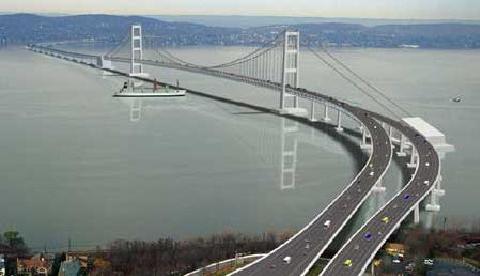
Imagine the northeast corridor without power for three weeks. Imagine an entire metropolitan area without access to clean drinking water because the sewage system failed. Consider a bridge that serves 100,000 people a day, such as the Tappan Zee, collapsing and cutting an artery into the largest city in our country. These are the real, entirely viable issues that our politicians are sweeping under the carpet.

Fortunately, not all of our friends in the Government are ignoring the issue. The Governor of Pennsylvania, Ed Rendell, is featured in an Op-Ed piece in The New York Times titled, "What's Wrong With Us?", and it questions how long we can continue on as a nation without reinvesting in our infrastructure system. It's nice to know that at least one of them gets it.

Gov. Ed Rendell likes to tell a story that goes back to his days as mayor of Philadelphia.

As he recalled, the city had a long cold snap with about a month and a half of below-freezing temperatures. Then, abruptly, the mercury rose into the 60s, he said, “and 58 of our water mains broke, causing all sorts of havoc.”

The pipes were old. Some were ancient. “My water people told me that some had been laid in the 19th century,” said Mr. Rendell, “and they were laid shallow, without much protection. So with any radical changes in temperature, they were susceptible to breaking. We had a real emergency on our hands.”

Infrastructure, that least sexy of issues, is not just a significant interest of Ed Rendell’s; it’s more like a consuming passion. He can talk about it energetically and enthusiastically for hours and days at a time. He has tried to stop the hemorrhaging of Pennsylvania’s infrastructure, and he travels the country explaining how crucially important it is for the United States to rebuild a national infrastructure landscape that has deteriorated so badly that it is threatening the nation’s economic viability.

Two years ago, a bridge inspector who had stopped for lunch in Philadelphia’s Port Richmond neighborhood happened to glance up at a viaduct that carries Interstate 95 over the neighborhood. He noticed a 6-foot crack in a 15-foot column that was supporting the highway. His sandwich was quickly forgotten. Two miles of the highway had to be closed for three days for emergency repairs to prevent a catastrophe from occurring.

These kinds of problems are not peculiar to Pennsylvania. New Orleans was lost for want of an adequate system of levees and floodwalls. Lawrence Summers, President Obama’s chief economic adviser, tells us that 75 percent of America’s public schools have structural deficiencies. The nation’s ports, inland waterways, drinking water and wastewater systems — you name it — are hurting to one degree or another.

Ignoring these problems imperils public safety, diminishes our economic competitiveness, is penny-wise and pound-foolish, and results in tremendous missed opportunities to create new jobs on a vast scale.

Competitors are leaving us behind when it comes to infrastructure investment. China is building a network of 42 high-speed rail lines, while the U.S. has yet to build its first. Other nations are well ahead of us in the deployment of broadband service and green energy technology. We spend scandalous amounts of time sitting in traffic jams or enduring the endless horrors of airline travel. Low-cost, high-speed Internet access is a science-fiction fantasy in many parts of the United States.

The article goes into depth about troubles just his state is facing, much less the rest of the country. But his point is on target--while the rest of the world eclipses this country by constructing massive high-speed rail systems, efficient public transportation systems, renwable green energy and metropolitans with sustainability as a goal...we are just left in the dust. And if we don't do anything about it, we will remain behind, never with the chance to catch up.

Thursday, February 4, 2010

Is Obama's High-Speed Plan the Best Use of Transportation Funds?

Going along with my last entry, here is an article that talks about the dire need this country is in for transportation options. However, it questions the fiscal responsibility of spending $8 billion on high-speed rail when our own local rail services are either dilapidated, underfunded or completely non-existent.

Amid great fanfare, the Obama administration last week announced plans to spend $13 billion in “seed money” for 13 high-speed rail projects around the country — $8 billion in stimulus funding now with a promise to seek $5 billion more over the next five years.

Among the projects being funded is the St. Louis-to-Chicago route, which will receive $1.1 billion. A relative pittance of $31 million went to Missouri to upgrade service between St. Louis and Kansas City.

With apologies to futurists, people in the construction industry and rail buffs, investing $13 billion (or even $8 billion) in passenger railroads is a little like building a bridge to the 19th century. It’s not enough money to make trains fast enough, attractive enough and affordable enough to attract sufficient passengers to operate without massive government subsidies.

This view puts us in company with the Cato Institute, the Heritage Foundation and others whose views we don’t usually share. And perhaps we’re being short-sighted: It could be that 50 years from now, America will be glad it invested in high-speed rail.

But right now, there are far better, fairer and faster ways to stimulate the economy than spending $8 billion on the relatively affluent 1 percent of Americans who ride trains. Public transit immediately comes to mind. Missouri got $31 million to upgrade St. Louis-to-Kansas City service that served 150,000 passengers last year. The state also subsidizes those twice-daily trains with $5 million a year.

Meanwhile, the Metro transit service in St. Louis — which carried 353 times more passengers than the state’s two Amtrak trains last year — gets zero in state tax subsidies, though the Legislature last year appropriated $12 million in federal stimulus money to temporarily offset crippling transit cuts.

The $1.1 billion that Illinois received for the Chicago-to-St. Louis trains is enough to pay for about a fourth of what it would take to upgrade the service to handle 90-mile-an-hour trains along its entire route. The 110-mile train might cut the scheduled 5-hour, 40-minute travel time between the two cities by less than an hour.

[Click for the full article]


While I am a major supporter of bringing transportation to this country, it does appear that helping out local cities and states is more important than helping the 1% of Americans who currently utilize rail for their travel needs.

Monday, October 26, 2009

Thursday, October 15, 2009

Supply-Chain Management: Freight Planning.

Since I am a Logistics major, and since I study it incessantly, I thought maybe it's time to share with you a little about Freight Planning.

But first off, I'll let let the US Department of Transportation give you a great understanding of specifically what Supply-Chain Management is, and the importance of reliable, efficient modes of transportation.


They did a pretty good job, huh? Hopefully that gives you a visual understanding of how the supply-chain works. However, the supply-chain is more than just different vehicles utilized to carry products--it is the entire process that begins with raw materials and ends with the product in the consumer's hand. For a more formal definition:
Supply chain management (SCM) is the control of materials, information, and finances as they move in a process from supplier to manufacturer to wholesaler to retailer to consumer. Supply chain management involves coordinating and integrating these flows both within and among companies. The ultimate goal of any effective supply chain management system is to reduce inventory (with the assumption that products are available when needed).
So you see, the supply-chain is just not "boats-to-trucks-to-home", it is the entire system in place that brings goods to people. It includes the inventory that sits on a shelf, the raw materials necessary to produce a single unit, the people required to coordinate the creation and transportation of a product, the financial data necessary to continue to produce a product, so on and so forth.

Focusing specifically on Freight Planning, there are many, MANY questions to consider:
  • Is the current system working?
  • Is the current system under/over utilized?
  • Does the current system provide enough capacity to hold future freight loads in 2035?
  • What are the environmental impacts of rail freight versus truck freight?
  • What are the costs associated with rail, truck and ocean freight?
That is simply the beginning. Currently in North America more than 6,500,000 trucks travel on our highways. Due to linking rail and ocean freight, most trucks travel only within 50 miles of their base (although there are many outliers to this generalization). By 2035, however, this number is expected to dramatically increase, causing usage to balloon to over 600 million miles per day. Looking at the maps below, you can see where the increase in highway congestion will appear:

2002 of Highway Congestion

2035 Projected Map of Highway Congestion


Can you even see the states of Ohio, Ilinois, Indiana or Kentucky? This unfortunate truth gives us three options: we can expand the highways, expand the runways or expand the railways. I, along with the rest of sensible people, recommend expanding the railways.

CSX is one of the largest private rail companies in North America. Historically rail has been unreliable, hence the shift to relying on trucks instead. However, companies are recognizing that rail is CHEAP--like, real cheap. For example, a CSX Train can take one ton of goods 427 miles on a single gallon of gas. Is that not insane? As a private company, they are constantly seeking ways to improve, and since 1980 they have improved efficiency 80%. In addition, rail is not only the cheaper way to go--it is the more environmentally friendly way, too! Look at this graph on the difference in carbon emissions between a trailer traveling 1000 miles on a truck and a 1000 miles on a train:


Clearly, rail provides better financial outcomes and environmental stewardship. However, rail moves slower--and it isn't as direct. It is impossible to route trains to be able to deliver all kinds of material right to your doorstep. That is without question. However, planning practices that support rail and provide for a larger system across our country would significantly reduce transportation costs for a company and cut out carbon emissions by a huge margin. In addition, AMTRAK could utilize the rails to provide better commuter service. And, if there is one thing about transportation, it is this--it goes hand-in-hand with economic development. Just as a coastal city cannot trade if there is no port to receive goods at, a city cannot grow without modes of transportation for people to utilize. It will become stagnant. It will lose it's attractiveness and luster. It will, essentially, be Columbus.

Reduced Costs, High Environmental Stewardship, Better Transportation Options and less congestion on highways? And people argue against this?

Now you know why I'm going into the private sector and not into planning.

Monday, February 9, 2009

Thursday, November 13, 2008

California High-Speed Rail.


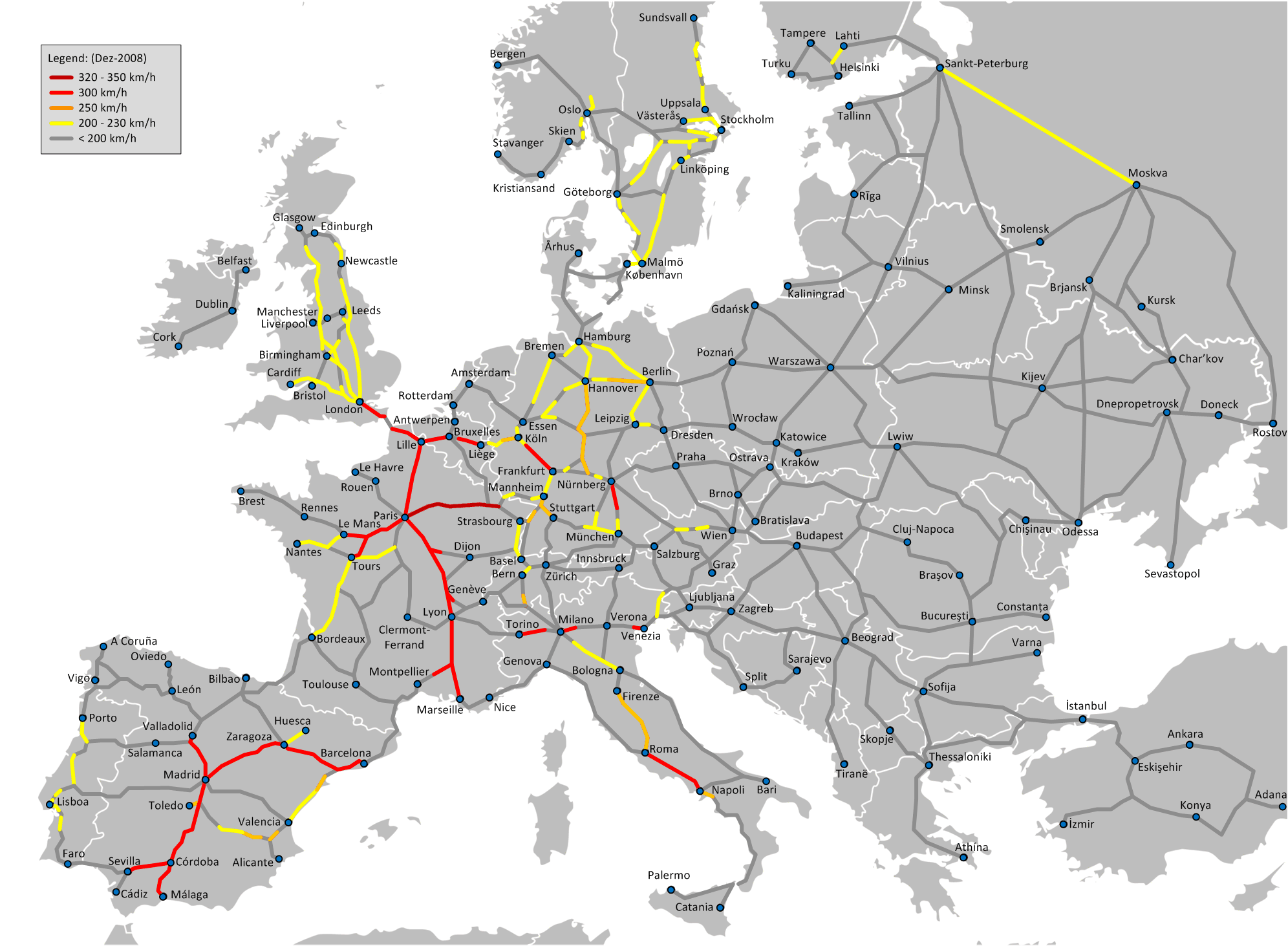
This would be the first of its kind in America. Now, not to squash any hopes here, but look at High-Speed Rail in Europe. It's far superior.


Click Image to Enlage.

One day I'd love to see America like this. Is it likely? Probably not. But it still can't hurt to hope.

(Via Trains for America and Changing World)

Thursday, November 6, 2008

A Great Day For Transportation!

Alright duckies, it's getting late and I don't have time to separate these into different posts...so here you go, all at once!

High-Speed Rail Coming to California!

Steel-Rail Transit Coming to Hawaii!

Passenger Rail Gains Favor in Congress!

A great day for transportation, indeed.

Monday, November 3, 2008

Capitalism Wins Again!

Remember that thing called "The Space Race"? Although not everyone believes we won it, in the minds of the sane we did. And what a feat that was! Our country made it to the moon first. Americans were the triumphant innovators of the day! We sure showed those nasty Communists that Capitalism always wins! Only problem is Russia might beat us at something else, something far more important--transportation here on Earth.

Spain to help build Russian railways.
Russian Railways is seeking Spanish expertise in a multi-billion dollar investment project. Spain is ready to help build high-speed railways in mountainous areas and supply trains with an automatic gauge changing system.

Welcomed by the King of Spain and the country’s top officials, the head of Russian Railways, Vladimir Yakunin, went to Madrid as an old friend and a trusted partner.

Russian Railways has a multi-billion dollar investment plan for rail infrastructure - a vital project in times of economic turmoil, according to Yakunin.

“The problem is not only the liquidity of banks, but also the support of the demand – the market, the real economy. So, because of that, we consider it is absolutely essential to keep the infrastructural investment programmes in tact,” he says. Russian authorities are considering co-operation with Spain’s INECO to build a high speed railway that will carry passengers from Moscow to Sochi in less than 24 hours.

As for international cargo, even high-speed trains have to cope with a variation of track gauge among different countries. Spain has a solution - Talgo carriages that can alter the gauge on the go.Mario Oria, Talgo’s export and marketing manager says: “We are hoping that the Russian market becomes the biggest in that share. Ideally, we’d be talking about 20-30 % of overall sales.”

Talgo’s trains can boost cargo volumes from Russia to the EU countries and significantly cut delivery times. Russia has already finished testing the Talgo system and is likely to buy the first ten trains, worth 15 million euros each, as soon as 2011.

Wow, if Moscow gets High-Speed Rail before Los Angeles or San Francisco, I think Ronald Reagan will dig himself out of his grave and begin writing an apology to the American people. (As if he shouldn't already do that, but that's another story...)

(Via Trains for America)

Tuesday, July 29, 2008

The Race America Doesn't Want to Win.

America is in a race, she just doesn't know it. It's a race to see where America will be in twenty years. It's a race against herself...and currently she's losing. It's a transportation race, and right now the question that every Americans needs to be asking is--when will America wake up, pick up the pace and start running again?

You probably have noticed that there are transportation problems in this country: Congestion in LA is a horrendous nightmare. Road rage is out of control in Miami. Bridges in Minneapolis are collapsing. And New York City is charging you a fee if you drive into the city (though this is a good thing, I swear). Point is, America knows she has problems with her transportation networks, she just doesn't care. AMTRAK is so poorly underfunded and has been since it became nationalized in 1971. The Government gives the Federally owned AMTRAK less than $1 Billion per year; our friends in congress give the private flying industry over $14 Billion per year. Something is wrong with that, isn't it?

Fortunately, things are changing. Two bills have been proposed and passed: HR 6003 and S. 294. Both bills have passed with a veto-proof majority, meaning that although Mr. George W. Bush has threatened to can the project, he won't be able to. Currently the bill is going into conference committee, which is the last step before Dubya signs it--which he will, and must. These bills effectively shell out $14 Billion for new transportation mediums. One of the recipients will be right here at home, The Ohio Hub Project.


This project will give birth to the dreams of many homegrown Ohioans--a high-speed rail that travels through all the big C's: Cincinnati, Columbus and Cleveland. Did you ever hear your grandparents talking about this one? (I know I have. They'd be sitting with the family, starry-eyed, dreaming of how glamorous and romantic it could be to just take the train from Cleveland to Columbus.) The plan will be to connect Ohio to already existing rails, going as far north as Ontario and as south as Southern Indiana. The proposal is for high-speed, 110 MPH trains that would make it possible to go from Cincy to Cleveland in 2.5 hours. By connecting the other rail lines in Pennsylvania, Indiana, Illinois and Michigan, it would be possible to get from Columbus to Chicago in 4 hours, from Pittsburgh to Indianapolis in 3.5 hours, and from Cleveland to Detroit in less than 2 hours. (Though this connectivity is part of a later phase).

Why is it so important that we switch to rail? The environmental impact of our cars is certainly nothing to sweep under the rug, but if self-interest is what sways your opinion, than consider that high-speed rail is safer than flying, easier than driving, cheaper than any alternative and is a perfect travel option for citycenter-to-citycenter business travel. Also, since 30% of flights don't leave on time, an efficient and brand new rail line will be a hell of a lot more reliable than the failing airline industry.

The options are this--expand the highways, expand the runways or expand the railways. We are a growing country and we're projected to have 404 million people by 2050; what are we gonna do with all of those people? How are we going to move them around? Certainly we've seen the failures of trying to run a country with "everyone has at least 1 car" city planning, and it's blown up in our face: we've had more people die on our highways than we have in all of our wars--combined. Our country cannot continue to function like this. Support high-speed rail and any initiative that promotes improving transportation options. We cannot continue running in a race we admittedly would like to lose.