Showing posts with label Transportation Planning. Show all posts

Thursday, February 4, 2010

Is Obama's High-Speed Plan the Best Use of Transportation Funds?

Going along with my last entry, here is an article that talks about the dire need this country is in for transportation options. However, it questions the fiscal responsibility of spending $8 billion on high-speed rail when our own local rail services are either dilapidated, underfunded or completely non-existent.

Amid great fanfare, the Obama administration last week announced plans to spend $13 billion in “seed money” for 13 high-speed rail projects around the country — $8 billion in stimulus funding now with a promise to seek $5 billion more over the next five years.

Among the projects being funded is the St. Louis-to-Chicago route, which will receive $1.1 billion. A relative pittance of $31 million went to Missouri to upgrade service between St. Louis and Kansas City.

With apologies to futurists, people in the construction industry and rail buffs, investing $13 billion (or even $8 billion) in passenger railroads is a little like building a bridge to the 19th century. It’s not enough money to make trains fast enough, attractive enough and affordable enough to attract sufficient passengers to operate without massive government subsidies.

This view puts us in company with the Cato Institute, the Heritage Foundation and others whose views we don’t usually share. And perhaps we’re being short-sighted: It could be that 50 years from now, America will be glad it invested in high-speed rail.

But right now, there are far better, fairer and faster ways to stimulate the economy than spending $8 billion on the relatively affluent 1 percent of Americans who ride trains. Public transit immediately comes to mind. Missouri got $31 million to upgrade St. Louis-to-Kansas City service that served 150,000 passengers last year. The state also subsidizes those twice-daily trains with $5 million a year.

Meanwhile, the Metro transit service in St. Louis — which carried 353 times more passengers than the state’s two Amtrak trains last year — gets zero in state tax subsidies, though the Legislature last year appropriated $12 million in federal stimulus money to temporarily offset crippling transit cuts.

The $1.1 billion that Illinois received for the Chicago-to-St. Louis trains is enough to pay for about a fourth of what it would take to upgrade the service to handle 90-mile-an-hour trains along its entire route. The 110-mile train might cut the scheduled 5-hour, 40-minute travel time between the two cities by less than an hour.

[Click for the full article]


While I am a major supporter of bringing transportation to this country, it does appear that helping out local cities and states is more important than helping the 1% of Americans who currently utilize rail for their travel needs.

Comparing Transportation Systems.


Having spent the majority of my life in the Washington-DC area, I'm quite familiar with what it's like to have an efficient public transportation mode at your doorstop. While people certainly have their complaints with the METRO, it still stands as one of the cleanest, youngest, most efficient system in the country. The above image is a shrunken image of an interactive map that compares the five largest systems in the country. In order, they are:
  • New York City (NYCT)
  • Chicago (CTA)
  • Washington DC (WMATA)
  • San Francisco (BART)
  • Boston (MBTA)
I, lovingly, refer to Boston's system (which is simply called the "T"), as the "dir-T". One can't lie, it's kind of gross. But I'd still take it over what's going on here in Columbus!

Report after report shows the dire need our country is in for more transportation options. For example, the American Society of Civil Engineers released a report last year giving our country's infrastructure a D average. Even with Obama's Reinvestment Act, there is still so much more this country needs in order to maintain competitive with the rest of the world. While I've never considered myself a fiscal democrat, this is one issue that I couldn't be more left on.

Think of it like this: the basic premise of an economy is the exchange of goods. In order for this exchange process to occur, there must be reliable, efficient networks of transportation. With a government that doesn't maintain its infrastructure, the possibility of this exchange dampens. As the rest of the world eclipses the US with their high-speed rail systems, for example, why would businesses want to continue with our outdated systems? Why focus a business strategy on utilizing rail to ship to Kansas City at an average speed of 33 MPH when goods can be shipped across China at over 100 MPH at a cheaper-per-mile rate?

So it's not just public transportation that needs investment--it's the grand picture of transportation. Fortunately, at least our current administration has a vision of achieving that picture. A vision, however. Not a reality.

Thursday, January 7, 2010

America's Top Ten Transportation Topics for 2010.

I did not write this, but the author's name is not mentioned.

(Washington, D.C.) As America enters a new decade, what will be the buzz about transportation? Clearly a safe, efficient, and viable transportation network should be at the forefront of issues facing policymakers at all levels of government and in all areas of our society in the coming months.

"In the year 2010, we'll be seeing more job-creating construction zones on our highways, but we will still need a long-term solution to address everything from fixing potholes to making needed repairs to our aging infrastructure," said Larry "Butch" Brown, president of the American Association of State Highway and Transportation Officials (AASHTO) and executive director of the Mississippi Department of Transportation. "Even more critically for the long-term health of this nation, 2010 must also be about how smart we become at enabling goods and products to get from one point to another with speed and efficiency."

Looking ahead, AASHTO has developed a list of the top ten transportation topics that it forecasts will be part of the national conversation in 2010 - in the media, in government and around the dinner table.

1) Adopting a long-term transportation funding bill
The current legislation that establishes funding levels and policy priorities for highways and transit expired on September 30, 2009. Since then, there have been four extensions - the most current being a short-term surface transportation authorization that will allow state departments of transportation to continue to use federal funds for highway, transit, and other projects until Feb. 28. Stop-gap extensions create difficulties for state departments of transportation since they cannot make long-term plans and commitments for more ambitious projects. In addition, without action by the Congress by March 1, state DOTs will lose $12 billion in 2010 for their highway programs. State DOTs need program continuity and stability through an extension of at least a year to adequately plan, execute and manage transportation capital programs.

2) Adopting a New Jobs Creation bill
The Senate is expected to begin debate on a jobs creation bill in mid-January. The House bill, Jobs for Main Street Act, contains several important transportation provisions including an extension of surface transportation authorization through Sept. 30, 2010. Funding would include $27.5 billion for highways and $8.4 billion for mass transit; Amtrak would receive $800 million while airports would get $500 million and shipyards $100 million. States have identified more than 9,500 ready-to-go projects that can fund projects quickly and put people to work. A jobs bill will enable states to build on last year's American Recovery and Reinvestment Act (ARRA) projects and keep the momentum going.

3) Deterring Distracted Driving
Nearly 6,000 people lost their lives in motor vehicle crashes involving some form of driver distraction during 2008. Nineteen states and the District of Columbia prohibit drivers from text messaging while driving; 12 of those laws passed in 2009. Florida and Kentucky have already pre-filed texting ban bills for the 2010 legislative session, according to the National Conference of State Legislatures. President Obama has banned texting by federal government employees while on official business or using government property and AASHTO has passed a resolution encouraging employers and state departments of transportation to enact similar bans. The year ahead will offer more public information campaigns and driver education, more sanctions and additional research to determine the extent of the problem, whether hands-free devices are an effective solution, and whether effective enforcement strategies can be developed and/or implemented. See http://safety.transportation.org for information.

4) Ensuring Safer Roads
In Spring 2010, AASHTO will publish the Highway Safety Manual. This manual will assist highway agencies as they consider improvements to existing roadways or as they are planning, designing, or constructing new roadways. AASHTO is working with the Federal Highway Administration and the Transportation Research Board to develop training, information sessions and other implementation tools that will be made available to states and others in the highway industry. AASHTO's goal: cut today's 38,000 highway fatalities 50 percent in 20 years.

5) Moving on High-Speed Rail Grants
Early in 2010, a new era in U.S. intercity passenger rail service will be launched with the announcement of $8 billion in ARRA grants for state projects to initiate or improve high-speed and intercity passenger rail service. Later in the year an additional $2.5 billion will be awarded through the State Capital Grants Program of the Passenger Rail Investment and Improvement Act to carry out President Obama's strategy for passenger rail. http://www.aashtojournal.org/Pages/110609transit.aspx

6) Taking Action to Address Climate Change
With autos and light-duty trucks contributing approximately 17 percent of the greenhouse gases (GHG) in the United States, state and local governments are developing climate change action plans and looking at the best ways to reduce emissions through technology, research, smarter travel, better cars and fuels, and improved efficiency and operation of our roads. In the year ahead, Congress will address this issue in both climate change and transportation authorization legislation. AASHTO's Climate Change Steering Committee is working to provide technical expertise and assistance to state DOTs to reduce GHG emissions. http://realsolutions.transportation.org/Pages/default.aspx

7) Responding to Increased Congestion Due to Capacity Issues
In 2008, high gas prices drove thousands of commuters from their cars and onto buses, subways and other transit options. As gas prices moderated, however, many of these riders went back to their vehicles. In fact, despite the economic downturn, 64 of the 100 most populated cities saw increased congestion in the first six months of 2009. This congestion will only continue to worsen as more people move to metropolitan areas and little is done to increase the capacity of the overall transportation system. In early 2010, AASHTO will issue a new report that outlines a four-point plan to address the urban mobility challenge. Other reports on the transportation needs of rural and underserved areas as well as freight will follow.

8) Adopting Social Media to Provide the Latest Traffic and Travel Information
Eighty percent of state departments of transportation are now using Twitter as well as an array of other "social media" to release information on traffic incidents, road closings, weather emergencies and other transportation-related information. Thousands of travelers have signed up to use this service. In Mississippi, Twitter sites have been set up to guide drivers through hurricane evacuations. Other media being accessed by states to educate their publics include Facebook, weekly news webchannels, podcasts and RSS feeds to spread their message. States are encouraging the use of these media "before they go" to avoid distracted driving.

9) Enhancing Safety through Roadway Improvements
On two-lane rural roads and major highways, rumble strips are now being installed to warn drivers when their vehicles start to leave the travel lane. On divided highways, cable median barriers are being installed to prevent fatal crashes in which vehicles run off the road into the median and cross over into oncoming traffic. With more than half of the highway fatalities occurring on rural roads, highway agencies are focusing on installing these types of lower-cost treatments to reduce these crashes. As additional studies are performed to demonstrate the effectiveness of these treatments, they will be installed on more roads across the country.

10) Creating more livable communities
The Administration has made livable communities a key aspect of their agenda. In June of 2009, EPA, HUD and USDOT entered into a Sustainable Communities Partnership to help improve access to affordable housing, provide more transportation options, and lower transportation costs while protecting the environment in communities nationwide. Efforts by state DOTs in the coming year will include building transportation enhancement projects such as bikeways, pedestrian walkways, historic restoration and beautification projects; improving metropolitan mobility; ensuring more transit services are available in rural areas and to serve aging populations; and adding capacity to our transportation network to reduce congestion and the amount of time commuters, truckers and other drivers are stuck in traffic and so have more time with their families.

Monday, October 26, 2009

Thursday, October 15, 2009

Supply-Chain Management: Freight Planning.

Since I am a Logistics major, and since I study it incessantly, I thought maybe it's time to share with you a little about Freight Planning.

But first off, I'll let let the US Department of Transportation give you a great understanding of specifically what Supply-Chain Management is, and the importance of reliable, efficient modes of transportation.


They did a pretty good job, huh? Hopefully that gives you a visual understanding of how the supply-chain works. However, the supply-chain is more than just different vehicles utilized to carry products--it is the entire process that begins with raw materials and ends with the product in the consumer's hand. For a more formal definition:
Supply chain management (SCM) is the control of materials, information, and finances as they move in a process from supplier to manufacturer to wholesaler to retailer to consumer. Supply chain management involves coordinating and integrating these flows both within and among companies. The ultimate goal of any effective supply chain management system is to reduce inventory (with the assumption that products are available when needed).
So you see, the supply-chain is just not "boats-to-trucks-to-home", it is the entire system in place that brings goods to people. It includes the inventory that sits on a shelf, the raw materials necessary to produce a single unit, the people required to coordinate the creation and transportation of a product, the financial data necessary to continue to produce a product, so on and so forth.

Focusing specifically on Freight Planning, there are many, MANY questions to consider:
  • Is the current system working?
  • Is the current system under/over utilized?
  • Does the current system provide enough capacity to hold future freight loads in 2035?
  • What are the environmental impacts of rail freight versus truck freight?
  • What are the costs associated with rail, truck and ocean freight?
That is simply the beginning. Currently in North America more than 6,500,000 trucks travel on our highways. Due to linking rail and ocean freight, most trucks travel only within 50 miles of their base (although there are many outliers to this generalization). By 2035, however, this number is expected to dramatically increase, causing usage to balloon to over 600 million miles per day. Looking at the maps below, you can see where the increase in highway congestion will appear:

2002 of Highway Congestion

2035 Projected Map of Highway Congestion


Can you even see the states of Ohio, Ilinois, Indiana or Kentucky? This unfortunate truth gives us three options: we can expand the highways, expand the runways or expand the railways. I, along with the rest of sensible people, recommend expanding the railways.

CSX is one of the largest private rail companies in North America. Historically rail has been unreliable, hence the shift to relying on trucks instead. However, companies are recognizing that rail is CHEAP--like, real cheap. For example, a CSX Train can take one ton of goods 427 miles on a single gallon of gas. Is that not insane? As a private company, they are constantly seeking ways to improve, and since 1980 they have improved efficiency 80%. In addition, rail is not only the cheaper way to go--it is the more environmentally friendly way, too! Look at this graph on the difference in carbon emissions between a trailer traveling 1000 miles on a truck and a 1000 miles on a train:


Clearly, rail provides better financial outcomes and environmental stewardship. However, rail moves slower--and it isn't as direct. It is impossible to route trains to be able to deliver all kinds of material right to your doorstep. That is without question. However, planning practices that support rail and provide for a larger system across our country would significantly reduce transportation costs for a company and cut out carbon emissions by a huge margin. In addition, AMTRAK could utilize the rails to provide better commuter service. And, if there is one thing about transportation, it is this--it goes hand-in-hand with economic development. Just as a coastal city cannot trade if there is no port to receive goods at, a city cannot grow without modes of transportation for people to utilize. It will become stagnant. It will lose it's attractiveness and luster. It will, essentially, be Columbus.

Reduced Costs, High Environmental Stewardship, Better Transportation Options and less congestion on highways? And people argue against this?

Now you know why I'm going into the private sector and not into planning.

Wednesday, October 7, 2009

Bike Traffic.

This is cute. Well, cute if you can imagine there ever being Bike Traffic in the USA.

Tuesday, October 6, 2009

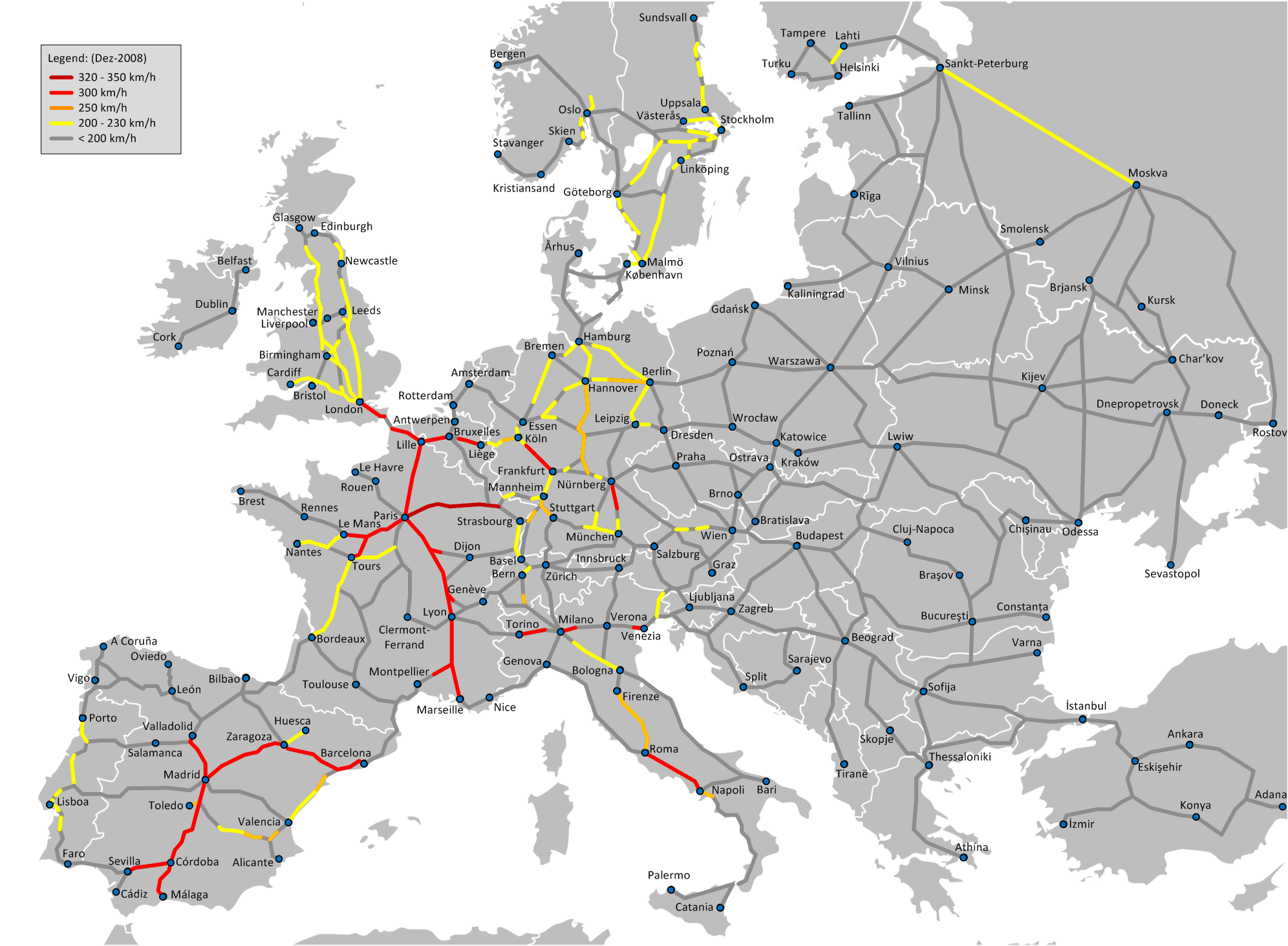
The System Map of France.

At over 260,000 square miles, and with a population of over 65 million people, France is not a small country. For comparison, the total area of France is larger than Ohio, Virginia, Tennessee, Kentucky, Indiana, South Carolina and West Virginia--combined.


And yet a country such as France can have a system map that rivals independently each one of these states. The mobility for the French, and for the rest of Europe, acts as a catalyst for more business opportunities, higher quality of life for the citizens and for sustainable infrastructure that doesn't need to be updated every 20 years. Why, oh why, does the United States rely so heavily on the automobile when other countries provide transportation options like this to their citizens which in the end raise the standard of living for everyone?

Just look at how the many nations of Western Europe have built a system together that mutually serves their part of the continent! Why is it that "the best country in the world" can't even get rail into the states like Texas with 34 million people, or in Ohio with 12 million, yet it can be done all over Portugal with 10 million?

I realize it just seems like I whine and complain incessantly about the void of transportation options in this country, but I just feel so helpless. Even with my rants, the people I am close with have no desire to demand change. Much less do the other 304 million people care! They are far more concerned with watching spectacles like Glee or American Idol than actually caring about the state of country that they call the greatest in the world.

Monday, October 5, 2009

Ohio Fails Again.

Ugh. My endless lamentations about how awful transportation in Ohio is never seem to come close to resolution. My complaints are founded on the lack of intercity rail, the seemingly nonexistent state commuter rail and the incredible reliance that the 7th largest state in the US has on the single-use automobile. I recognize, however, when efforts towards smoother transportation-system use are made and try to be optimistic towards these efforts.

Recently the Ohio Department of Transportation had a slight opportunity to improve highway efficiency with its E-Z Pass program for the Ohio Toll Road. Many states--including Maryland, Illinois, Pennsylvania, West Virginia, etc.--have implemented these fast-pass lanes with grand reception and simple implementation.

But, unfortunately, Ohio fails again.

The adage Keep It Simple, One Thing at a Time wasn't heard in Ohio.

Instead Thursday October 1 they had a cash toll hike plus the startup of electronic tolling simultaneously.

And they grossly overestimated first day uptake of electronic transponders.

Initial lane allocations were based on an estimate that first day penetration of E-ZPass transponders would be 30% of traffic.

The actual percentage Thursday, Day One, turned out to be about 10%, officials said.

E-ZPass Only lanes went unused while traffic backed up at cash lanes.

Plaza superintendents scrambled to change lane modes.

At first they changed dedicated E-ZPass transponder lanes to mixed mode.

[And] then there was sign confusion.

Mixed mode lanes signed everywhere else in Inter Agency Group country CASH/E-ZPass in Ohio were signed TICKETS/E-ZPass which apparently led many cash-paying motorists not to understand they could use the lanes.

So the mixed mode lanes went underused while traffic queues grew at the cash lanes. The Turnpike Commission apparently felt they couldn't call the non-E-ZPass lanes CASH because they have payment machines that not only accept cash, but also credit/cards.

[Continued in the article...]
From a planning perspective, Ohio is rarely the forefront state leading the way in unique initiatives. A few consummate examples of states really introducing unique planning practices include Maryland's Smart Growth program, Oregon's Urban Growth Boundaries, and California's Coastal Protection Program. Ohio has nothing like these. So am I surprised when a state that never introduces new ideas fails at ones that have already been properly executed?

Unfortunately, when the state is Ohio, the answer is no.

Sunday, October 4, 2009

More Rail Options in DC!

There are many, MANY reasons whyI do not like Ohio, but the lack of rail options is by far one of the biggest. Organizations like All Aboard Ohio are working hard to change this, but for now the reality still exists--if you're in Columbus, there ain't shit for transportation options. And this affects what Urban Planners define as "Transportation Behavior", which is the belief that your surrounding area,not your personal preference, will control which transportation mode you select. For example, you would be deemed insane if you were living in Westerville and decided to walk to work in Reynoldsburg. On the flip side, that's about the same distance between College Park, MD and Washington, DC--and thousands upon thousands of people use the bus and Metro system to make that journey. Why the change? Because frankly driving to DC is a pain in itself, and the parking fees are so astronomical that taking the metro is way more convenient! Here in Ohio we don't have those options, and because of this our transportation behavior is solely single-use automobile.

So, now get this. Virginia is about to launch rail service from Lynchburg to Washington DC, and it's part of a test to see how VA would benefit from more rail options. Why can't this happen here in the Buckeye State?
Virginia launches its first state-funded intercity passenger train Thursday from Lynchburg to Washington, a move that will enhance mass-transit options for Northern Virginia commuters and people across the state.

The new service is part of a $17.2 million, three-year pilot program the state is running, and fully funding, to determine whether enhanced rail service is viable in Virginia. The pilot program will offer two trains, one from Richmond and one from Lynchburg, that will travel to Union Station and then on to Boston. Service between the Virginia terminuses and Washington will include stops at some Virginia Railway Express stations; service between Washington and Boston will include stops in Philadelphia and New York.

However, the train set to run from Richmond will not launch until Dec. 15 because the necessary infrastructure improvements -- about $78 million worth -- are not complete, said Jennifer Pickett, a spokeswoman for the Virginia Department of Rail and Public Transportation. She noted that $43 million in improvements were completed so that the Lynchburg service could begin.

"This is a pilot project. It is the beginning of something, not the end of something," said Sharon Bulova (D), chairman of the Fairfax County Board of Supervisors. "We are going to see this grow."
It's sad that in one of the largest cities in the US (Columbus), there is no intercity rail service, nor is there any kind of commuter rail whatsoever. If Lynchburg, VA can get it (and St. Cloud, MN; Madison, WI; Portland, OR; etc.)...why can't we?

Tuesday, February 10, 2009

A New "Tragedy of the Commons".

The tale I hear from almost all of my City & Regional Planning professors goes something like this.

Back in the day, cities used to have wide open commons with plenty of grass so you could bring your sheep for a brief stay and not worry about them while away from your farm. However, because of this free resource, it was in each sheep herder's self-interest to crowd the common with as many sheep as possible, since it was a free resource. With the commons overrun by sheep, the once beautiful meadows would eventually reach destruction. The moral of the story is that because of the self-interest of a few, the majority would have to suffer the loss.

In Paris, a new tragedy of the commons has been found: The tragedy of Bike Sharing.

A popular bicycle rental scheme in Paris that has transformed travel in the city has run into problems just 18 months after its successful launch.

Over half the original fleet of 15,000 specially made bicycles have disappeared, presumed stolen.

They have been used 42 million times since their introduction but vandalism and theft are taking their toll.

The company which runs the scheme, JCDecaux, says it can no longer afford to operate the city-wide network.

Championed by Paris Mayor Bertrand Delanoe, the bikes were part of an attempt to "green" the capital.

Parisians took to them enthusiastically. But the bikes have suffered more than anticipated, company officials have said.

Hung from lamp posts, dumped in the River Seine, torched and broken into pieces, maintaining the network is proving expensive. Some have turned up in eastern Europe and Africa, according to press reports.

Since the scheme's launch, nearly all the original bicycles have been replaced at a cost of 400 euros ($519) each.

The Velib bikes - the name is a contraction of velo (cycle) and liberte (freedom) - have also fallen victim to a craze known as "velib extreme".

Various videos have appeared on YouTube showing riders taking the bikes down the steps in Montmartre, into metro stations and being tested on BMX courses.

Remi Pheulpin, JCDecaux's director general, says the current contract is unsustainable. "It's simple. All the receipts go to the city. All the expenses are ours," he said.

The costs, he said, were "so high that a private business cannot handle it alone, especially as it's a problem of public order. If we want the velib set-up to keep going, we'll have to change the business model," he told Le Parisien newspaper.

As much as I love the bike sharing program, I'm surprised no one thought this aspect of the program through. Why not require a credit card in order to rent the bike in the first place? If it is not returned within a long amount of time--say, a month--your credit card is charged for the amount of the bike? Maybe it's not a perfect suggestion, but it certainly beats how the program is running now.

Update: Stimulus Projects.

I have long been critical of the lack of information regarding the Economic Stimulus Plan. Every time President Obama has thrown out numbers I have been waiting for the cold, hard facts regarding these numbers.

Thanks to Stimulus Watch, I can finally feel satisfied. This website is tracking the spending plans of the stimulus by state or city and by project type:
The scope of this stimulus package is terrifying. I'm not sure whether I'm afraid of the cost or afraid of the implications--the revelation of just how bad the American infrastructure really is.

Monday, February 9, 2009

Fast Train.

Wheeeee!!!!!

(Read: Too Lazy for Real Update.)

Stimulus Plan: What Does it Mean for Transportation?

President Obama's stimulus plan has passed in the Senate, 61-36. With the hurdle of selling the bill to congress still before us, the topic I am most concerned about is transportation. The Senate Bill and the House bill differ on exact allocations of the funds for transportation projects and repairs, so I'm crossing my fingers that these projects don't get slashed from the bill in order to appeal to Congress. Perhaps the optimistic mentality should be to feel fortunate there are at least plans to improve our horribly inefficient transit systems in The United States.

Here is the basic plan (for now):
  • $850 million for Amtrak to achieve a state of good repair (Senate Version)
  • $2.25 billion for states to build and expand passenger rail (Senate)
  • $5.5 billion for a flexible surface transportation program for roads, rail and transit (Senate)
  • $12 billion for transit (House); $9 billion for transit (Senate)
For now these are just numbers and promises. Fortunately the Obama Administration is setting up Recovery.gov, a website for Americans to watch exactly how this stimulus package is being spent. I am so glad they are doing this. What a shock it is to have a Presidential Administration we can trust and hold accountable for the promises they've made us.

Monday, December 1, 2008

Bike Sharing Program in The US.

Remember when I lamented that bike sharing programs could never come to America? Well, I was wrong. And take a guess where it's coming...?
The mayor of Minneapolis is looking to join [European] cities' ranks and embrace [Minneapolis'] rising status as a bike-commuting town by dropping 1,000 bicycles into Downtown, Uptown and the University of Minnesota campus next spring.

Industry experts say technological advances have paved the way to make bike-sharing programs a reality. In Minneapolis, bikes would be secured in solar-powered docks, and bikes would be unlocked by a subscriber's key card.

The bikes Minneapolis would use were designed by Stationnement de Montréal, which, oddly enough, is Montreal's parking authority. The agency manages Montreal's paid on-street parking and public parking lots, and the company designed a bike-sharing program inspired by European programs already in place. Time magazine ranked Montreal's "Bixi" bike one of the 50 best inventions of 2008, and Montreal's program will also roll out next spring.

The Minneapolis bikes would have covered chains and gears internal to the hubs, so it's less easy for bikers to damage the three-speed mechanics. The broad frame is designed to be easy to clean and it has a large adjustable seat, a basket and a unisex design. Electric generation powered by movement of the front wheel would automatically light up rear lights on the bike.

Riders could take out the bikes for a half-hour at no extra charge. Annual subscriptions would cost $50–$75. The bike program is designed for quick one-way trips that are about one to three miles. Riders could check online to make sure bikes are available at the nearest dock, and when they arrive at their destinations, 1,500 more dock points than bikes should ensure there is space for bike returns. (In Barcelona, trucks redistribute bikes throughout the day to ensure adequate supplies.) Stations would be positioned about 400–500 meters apart so people theoretically wouldn't walk too far to reach their destinations.

The cost to install 1,000 bikes at 75 docks is estimated to be $3 million, and city officials have applied for a series of grants to pay startup costs. The City of Lakes Nordic Ski Foundation, the organization that runs the annual Loppet skiing event around the Minneapolis lakes, developed a nonprofit model that Minneapolis could use for its bike-sharing program.

Exact locations for bike docks aren't yet determined, but they would be movable. Consultants on the project say that will make our bike-sharing system a lot less expensive than the one in Paris, which has bike stations permanently entrenched in the ground. Minneapolis' bike stations would be removed during the winter.
I don't think I've ever been so happy to have been wrong.

Wednesday, November 26, 2008

Traffic Lights.

All your life you've seen the same damned traffic lights. Pretty much since they were invented they've remained the same design here in the US. They're yellow and boring. In this future-driven society, isn't it about time for an update? Isn't it time for a change you can believe in?

Presenting...the square traffic light!


Additional section also needs to be modified. Now drivers see green light when they are allowed to make the turn, but no light at all if they have to wait. There should be some symbol to display, to show the turn is not allowed (using two color diodes)

How cool is that? I say bring them on. (Except for the fact that our country is so broke they can't even afford to fix bridges. Or, really anything.)


(Via Luxofor)

Thursday, November 20, 2008

A Touch of Honesty.

Canadian City Planner Linda Allen has a dirty secret. Everyday she works to advocate more transit use, cycling instead of driving and every other effort to support sustainability. Her secret? She loves to drive.

Almost daily, I promote smart growth - alternative transportation choices, reduced greenhouse gases, increased housing densities.

It's my business to help Canadians understand and adapt to a future that is different from the past. I am a 21st-century city planner.

Along with fellow futurists, I advocate less vehicle travel, more cycling and transit use, smaller cars and sensible energy consumption. The terms "eco-density," "high-occupancy vehicles" and "environmental footprint" are common currency.

By day I'm committed to radical societal change. But my lifestyle is suspect because I really like to drive. Mostly by myself. Pedal to the metal. Wide-open spaces. No boundaries. Zoom, zoom, zoom.

It doesn't matter whether the vehicle is turbocharged, comes with a GPS or has leather seats. It just needs to be peppy and have a tight turning radius. It's about the essential pleasure of driving, regardless of make, model or colour.

I understand the disconnect between the extravagant past and our frugal future. My lifestyle is unsustainable and I need to change my patterns. But I subtly resist the shift. Perhaps it's the curse of the baby boomers. For our generation, driving has been a lifelong love affair, one that isn't easily surrendered.

My formative years were spent cruising small-town Ontario on sweltering summer nights in my mother's flashy turquoise convertible. A few years later, I was circumnavigating North America in a Volkswagen "shagging wagon."

As a responsible adult, driving became shuttling giggling, gossiping children to preschool, dance lessons and soccer tournaments in an all-purpose passenger van. But whenever possible it also meant navigating 16-lane California highways. Zipping through European roundabouts. Pushing through Albertan blizzards. Always plotting the next trip, whether 200 or 2,000 kilometres.

In my planning classes I've always found this hilarious. I cram into a room of 60 students, learn about the importance of reducing our carbon footprint and living green, then watch as 59 other students walk out of the class, across the street...to a parking lot. Although funny, it's concerning that even those who are well-educated in the perils of the oil crisis, the coming effects of global warming, the horrors of car-living and suburban sprawl still cannot give up their cars.

Wednesday, November 19, 2008

Brad Pitt on Transportation.

Brad Pitt will be narrating a PBS episode of "e2", a series devoted to educating its viewers on ways to improve our world and our environment. The topic? Transportation. It will debut online on November 24th.

Here's a quick preview.


Bike sharing seems like a fantastic idea, but here in the US? Please. Americans complain about having to pay a gas tax, I can't imagine the whining that would ensue if they'd have to--gasp!--pay for someone not to drive. It yet again reminds me of how far ahead the rest of the world is compared to us in The United States (...sigh...)

Also, for more great videos from e2 about sustainability, click here.

Monday, November 17, 2008

Baghdad To Build Subway.

Oh, I wish I hadn't seen this article. I really wish I hadn't.

BAGHDAD – Iraq plans to build a subway in Baghdad to help cut pollution and ease traffic on the city's chronically clogged streets.

Baghdad Mayor Sabir al-Issawi said in statement released Monday that Iraq's Cabinet has earmarked $3 billion for the project.

The subway is the first in Baghdad and will have two lines.

One would run 11 miles from Shiite-dominated Sadr City in the east to the predominantly Sunni neighborhood of Azamiyah in northern Baghdad.

The second line would be cover 13 miles and link the mixed neighborhoods of central Baghdad to the primarily Sunni western suburbs. Both lines will have 20 stations.

Al-Issawi did not provide a timeline for the project.

Explain to me why we invade a country, spend over $1 Trillion on an unnecessary war, rebuild their Government and now we have to watch them introduce subways into their cities?! Here in The United States, the Chicago El routinely has trains derail, Cleveland's Rapid is thirsting for people to ride it, commuter trains crash in LA, Minneapolis has to fight to get a second light rail line approved, Columbus won't even let a $100 million Streetcar be built...and yet Baghdad can pull it off. BAGHDAD! The city that years ago was in utter turmoil, the city that today still has frequent bombings and mass-murder in the streets, the city that has thousands of troops planted there just to maintain the peace, the city that for quite some time didn't even have running watter. THEY can pull it off yet America can't?

*bangs head against wall*

I'm moving to Canada.

The Third Rush Hour.

Tyson's Corner, Virginia is what planners call an "edge city". An edge city is defined as having 465,000 square feet of office space, 600,000 sq. ft. of retail space and consists of more jobs than bedrooms. It's basically like a glorified office park with a big mall. I'm an avid critic of these concepts as they only promote auto-dependency, stress on the environment and in no way can complement a high-quality of life. The residents who do live there are bothered by incessant traffic during the day and nothing to do at night. The people who work there spend around one-to-two hours a day commuting to a sea of parking spaces and an office life void of character. It's really terrible.

So it's no surprise that a recent study informs that traffic is so congested in Tyson's Corner that there is now a third rush hour--when lunch time hits.

Having so many of the approximately 115,000 Tysons workers on the road, often driving less than a mile to grab a sandwich, is complicating construction plans for a Metrorail extension and Capital Beltway toll lanes that will rip up the streets around the area. An analysis of traffic counts shows more than 23,000 vehicles on the major Tysons thoroughfares, routes 7 and 123, between 11:30 a.m. and 2 p.m., surpassing the morning rush by 24 percent.

Things are so bad that traffic planners are introducing a lunchtime shuttle to try to get some of the vehicles off the road.

A lunchtime shuttle? Props to the planners for introducing a solution, but this problem shouldn't even exist in the first place. It's amazing how one can go to London, which is one of the world's largest metropolitans, and yet experience no problem like this whatsoever. You can thank General Motors and our policy makers of the 1950s for willfully destroying many public transportation systems throughout the country and thus putting us into the car-dependent society we live in. Today, as GM is asking for a multi-billion dollar bailout, I'm desperately hoping they don't get a cent from the Government.

Thursday, November 13, 2008

California High-Speed Rail.


This would be the first of its kind in America. Now, not to squash any hopes here, but look at High-Speed Rail in Europe. It's far superior.


Click Image to Enlage.

One day I'd love to see America like this. Is it likely? Probably not. But it still can't hurt to hope.

(Via Trains for America and Changing World)