
What's up with the dolls this week? Hoarders featured a freak who couldn't throw away his daughter's doll, RuPaul's Drag Race made the drag queens design a RuPaul Doll...and now this!
(Via After Elton)

 I'm disgusted with religion. One glance at this blog and that becomes immediately apparent. But what disgusts me even more is the flagrant misuse of authority as means to sexually abuse children under the guise of the "love of Christ". Story after story hits the press about priests abusing children, pastors molesting little girls, altar boys masturbating in front of the arch bishop...and yet the deluded minds of their followers do nothing. (Actually, instead of nothing, they willfully act to cover up the abuse and sweep the vitriol under the carpet as if it were bit of dust at the end of a long day.)
Last week, around 20 former students claimed they had been sexually abused by two teachers at the school, Wolfgang S. and Peter R. The abuse is believed to have been committed during the 1970s and 1980s.'Nothing To Apologize For'
After being contacted by SPIEGEL, one of the former teachers admitted he had abused some of his students. Wolfgang S., a former sports teacher and Jesuit priest, issued a statement to his victims stating it was "a sad fact that I abused children and young men under pseudo-educational pretexts." The churchman, who today lives in South America, said that he had informed regional Catholic authorities in Germany in 1991 of his "criminal past." He claims the Jesuit priests had known for 19 years about the multiple incidents of abuse.
Stefan Dartmann, the Catholic Provincial Superior for Germany, confirmed to SPIEGEL that the order has knowledge of the crimes that had been committed by Wolfgang S. at the time. Dartmann said a lawyer had been hired to investigate the files "to determine what, exactly, the Jesuits knew at the time and what consequences they drew." Wolfgang S. left the order in 1992. Previously, he is also believed to have abused pupils at other schools, but he refused to comment on those allegations.
In addition to his time at the Berlin school, he worked at the Sankt-Ansgar School in Hamburg and at the Sankt-Blasien school in the southern Black Forest region from 1982 to 1984.
'Intimate, Fatherly Behavior'
The then-director of the school, Father Hans Joachim Martin, said that S.'s "intimate, fatherly behavior" towards some schoolchildren had attracted his attention. S. was later forced to leave the high school.
S. also claimed he had told the Vatican about his misconduct. In his statement, he says that he had provided testimony to the Vatican with "unvarnished honesty." And in South America, he had "again and again come into close contact with the torturers and victims" of the Pinochet dictatorship. "I was confronted with my mirror image as a tormenter of children," he said.
Several victims expressed their outrage over the tone of his statement. In the document, dated Jan. 20, S. addressed "all the people who I abused as children and in their youth." He added, "I'm sorry for what I did to you. And if you are capable, I ask you to forgive me." But he also told SPIEGEL: "I have come clean about my past to God and the world."
The second man alleged to have abused children at the school is a 69-year-old former religion teacher from Berlin, Peter R., who has disputed all allegations. SPIEGEL could not reach R. for comment by press time on Friday or on subsequent attempts on Monday. After his time at the school in Berlin, R. apparently worked as a pastor with young people in the state of Lower Saxony. He was reportedly the victim of a knife attack by a former Canisius College student several years ago.
 Going along with my last entry, here is an article that talks about the dire need this country is in for transportation options. However, it questions the fiscal responsibility of spending $8 billion on high-speed rail when our own local rail services are either dilapidated, underfunded or completely non-existent.
Amid great fanfare, the Obama administration last week announced plans to spend $13 billion in “seed money” for 13 high-speed rail projects around the country — $8 billion in stimulus funding now with a promise to seek $5 billion more over the next five years.
Among the projects being funded is the St. Louis-to-Chicago route, which will receive $1.1 billion. A relative pittance of $31 million went to Missouri to upgrade service between St. Louis and Kansas City.
With apologies to futurists, people in the construction industry and rail buffs, investing $13 billion (or even $8 billion) in passenger railroads is a little like building a bridge to the 19th century. It’s not enough money to make trains fast enough, attractive enough and affordable enough to attract sufficient passengers to operate without massive government subsidies.
This view puts us in company with the Cato Institute, the Heritage Foundation and others whose views we don’t usually share. And perhaps we’re being short-sighted: It could be that 50 years from now, America will be glad it invested in high-speed rail.
But right now, there are far better, fairer and faster ways to stimulate the economy than spending $8 billion on the relatively affluent 1 percent of Americans who ride trains. Public transit immediately comes to mind. Missouri got $31 million to upgrade St. Louis-to-Kansas City service that served 150,000 passengers last year. The state also subsidizes those twice-daily trains with $5 million a year.
Meanwhile, the Metro transit service in St. Louis — which carried 353 times more passengers than the state’s two Amtrak trains last year — gets zero in state tax subsidies, though the Legislature last year appropriated $12 million in federal stimulus money to temporarily offset crippling transit cuts.
The $1.1 billion that Illinois received for the Chicago-to-St. Louis trains is enough to pay for about a fourth of what it would take to upgrade the service to handle 90-mile-an-hour trains along its entire route. The 110-mile train might cut the scheduled 5-hour, 40-minute travel time between the two cities by less than an hour.


 In case you were wondering what's going on with the Ibiza Project in the short north, Columbus Underground has the full story. (As does The Columbus Dispatch)


 A radio interview of Roosevelt University professor Dan Protess gives us the simple explanation of the social good that comes from street vendors, as well as the historical background on the limitations and restrictions of these vendors. Here is one statement that particularly stood out to me:
I won't lie, I don't eat food from street vendors. But then again, I'm a vegetarian, so what am I going to order? A dry bun?INTERVIEWER: Why do we outlaw street vendors in Chicago?
PROTESS: One, we have a very powerful restaurant lobby that did a lot to shoot down the smoking ban, if you recall a few years back and put that off for several years. And obviously they don't want the competition on their doorstep. I also think historically it's wrapped up in anti-immigrant sentiment. Historically, people looked down on Italians or Greeks were eating, and it was one thing for them to be eating their strange olive oil and garlic in their house, but it was another thing for them to be eating it right in front of us."
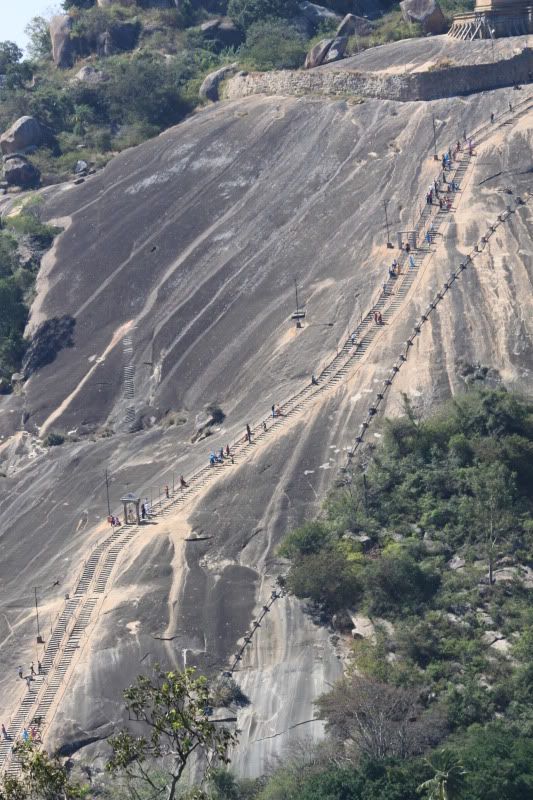
Here is a map of where the Bahubali is located in Western India:According to the traditions of the Indian religion Jainism, the son of the first Tirthankara (Ford-maker, i.e., saviour) Rishabhanatha. He is said to have lived many millions of years ago.
After winning a duel with his half-brother for control of the kingdom, Bahubali is believed by the Jains to have realized the transience of temporal affairs and renounced the world. According to legend he then stood immobile, with feet straight ahead and arms at his side, meditating for an entire year in the Yogic position of kayotsarga (“dismissing the body”). He was so unmindful of the world around him that vines grew undisturbed up his arms and legs and anthills rose around his feet. His meditation led him to true victory over human passion and, according to Digambara belief, enabled him to become the first human of this kalpa (world age) to gain liberation.
Several works of sculpture depict Bahubali, including an outstanding 9th-century bronze in the Prince of Wales Museum of Western India in Bombay. A colossal 10th-century sculpture stands atop a hill at Shravana Belgola (“White Lake of the Ascetics”), a centre for the Digambara sect in Karnataka state. Cut from a single block of gneiss, the figure stands 17.5 metres (57 feet) high and is one of the largest freestanding images in the world. Every 12 years, in one of the greatest Jain rites, the entire image is ceremonially bathed in curd, milk, and ghee before crowds of nearly a million people


Scenario one: A man is in a serious car accident is transported to a hospital where he is refused treatment because he cannot afford to pay.The lecture referenced has already passed, but I'm still intrigued to learn more about how we as a society view certain acts.
Scenario two: The day after a man dies his first born son gets a haircut and eats chicken.
Which do you think is a more serious moral transgression?
Gut reaction tells many of us that No. 1 is the obvious choice.
But on Thursday, Shweder will likely take people to the small town of Bhubaneswar in Orissa, India, where he has worked from time-to-time since 1968. It was there that Shweder learned that the first born’s actions in the situation above would be tantamount to throwing his father’s body in the garbage, thus putting the father’s soul in jeopardy.
“I’m going to try and take people into different worlds…worlds where they think that shame is a virtue, worlds in which they are more concerned about pollution and sanctity than about free choice,” Shweder said.
Shweder is a professor of human development and one of the founding fathers of cultural psychology.
“Cultural psychology is the study of the way cultural traditions and social practices regulate, express and transform the human psyche," writes Shweder in his book Thinking Through Cultures.
Through cultural psychology, Shweder challenges the one-size-fits-all path of general psychology. He also said cultural psychology runs counter to a “the West is best” assumption grown out of the Enlightenment.
He said the field has been staging a comeback since the 1980s as globalization has grown and cultures have begun to collide with regularity.
“It’s one thing to simply study differences, but once we come to moral values…the assumption is that you know what’s good for everyone else and he’s questioning this,” Katia Mitova said of Shweder. Mitova is coordinating the cultural center lecture series for The Chicago School of Professional Psychology.
Yet recently Shweder has run head-first into criticism for his views on Female Genital Mutilation (FGM), also called female circumcision. In the West, the surgical procedure is often viewed as a human rights violation with serious health risks.
Shweder said he believes the U.S. media have told only one side of the FGM story—an ethnocentric side that demonizes cultures, such as some African cultures, which practice the circumcision as an initiation rite.
“He does not shy away from controversy,” said Bettina Shell-Duncan, a professor of anthropology and global health at the University of Washington in Seattle.
Much of this debate is playing out in TierneyLab, The New York Times science blog by John Tierney, where Shweder has been contributing to a recent online dialogue about FGM. Reader comments are spilling in—at last count there were more than 450 of them— many with the kind of quick-fire repulsion that Shweder warns against. (Go to http://tierneylab.blogs.nytimes.com .)
“We all have very socialized or culturally-informed judgments that we make," said Shweder. "They happen rapidly…they often can be guiding us poorly.” At the heart of cultural psychology, he said, is an attempt to show how morally descent and rational people can make judgments with which you would disagree or even find morally repulsive.
For some in the West, the issue of female circumcision is simple: human rights trump cultural practices.
Shell-Duncan, who said she does not always agree with Shweder, said she believes the debate over female circumcision has been unbalanced in the U.S. “What Rick has done in these blogs is to open up a more nuanced debate,” she said.
He guides her up the stairs, lightly holding her hand as she takes each step. She's in her late 80's, hooked to a respirator. The gentleman carries it for her so she can focus all of her energy on making it to the door.
She slowly lifts each foot and trudges just a few inches. While only steps from the entrance, the gentleman reaches out to pull the door wide open for her. Her puts his arm around her and gently leads her into the restaurant. What would take a few second takes her a minute; yet she looks out into the world with the most poignant, devoted eyes.
Without letting go of his lady, he smiles and says to the hostess, “Table for two, preferably somewhere close.” He lets out a wink and a chuckle as he says it. He’s tall with a loud and commanding voice; yet he holds her with the care of the kindest soul.
When they arrive at their table, he lays down her respirator and begins to unbutton her jacket. Her eyes continue to dance around the restaurant, mesmerized by the flickering candles and variety of people. He takes his time to get every button out of its loop. “There’s no need to be hasty,” he explains to the hostess with a smirk.
Once unbuttoned the gentleman begins to slide her arms out of her jacket for her. She has no strength, and is visibly exhausted from making it this far. It is an effort just to move her hands. But she still continues to smile. A contagious smile. A smile that radiates and embraces the attention of everyone in the room.
He tenderly takes off her snow cap and does the same to his own. “Alright, ready to sit down my lady?”, he asks her with a grin. He then takes both of his hands and slowly helps her into her seat. Once she is taken care of, he then begins to think of himself. He quickly unbuttons his jacket and hangs it on a nearby hanger. He walks back, pulls out his seat and plops down into to it to look over the menu. She has yet to say anything at all.
The server walks up to them and welcomes them to the restaurant. "I'll have a Manhattan on the rocks, and the pretty lady over here is going to have a cola." Once the server departs he looks over the menu deciding what would be best for her. "Are you in the mood for fish today?", he asks her. She doesn't respond. Once the server returns, the gentleman says to him, "I think the two of us are ready to order. I'm gonna have the chef's Pasta Louise," pronouncing it 'lou-wheez-ee', "...and my lady is going to have the tilapia," pronouncing it 'til-ah-puh-ta'. The server walks away and suddenly it's just the two of them.
He extends one hand out towards her. She trembles for a moment and begins to lift her fingers and move in closer to him, inch-by-inch. Her entire body shakes as she draws near to him. And once she reaches him, they then sit, staring at one another, hands interlocked across the table, reminiscing of the good old times. The server is around the corner from them and overhears the gentleman say, "My lady, we've been one heck of a couple. You're my pal." He doesn't say, 'I love you' for one simple reason--he doesn't have to.
The server later stops by the table and the gentleman pipes in, "Did you know the two of us have been in Ohio for the past 50 years? We don't look it, do we!" She looks at the server and rocks her head back and forth. "Yup, me and this pretty lady met many, many years ago in Kentucky. We've had one heck of a journey."
When their food comes, before even looking at his own he reaches across the table and begins to cut her 'til-a-puh-ta' for her. He then patiently, effortlessly, wraps his fingers around her hand and guides her fork to her mouth, all the while not giving his own plate the slightest thought. When the server comes back and asks if there is anything he could give them, the gentleman answers, "Well, another 20 years sure would be nice."
They finish their meal and leave in the same way they arrived. The gentleman supports his lady in every way that she is immobile, and he does it all with such exuberant joy. The love the two of them share is so palpable that the entire restaurant is in tears. And as they walk towards the door, each slow step at a time, it becomes clear to those who saw them that every day is a gift, and what a gift it would be to spend a lifetime with a gentleman like him.
 Traveling to Vancouver was one of the greatest experiences of my life. I consider it a world city on par with London, Paris, New York City and Chicago. It's a city planner's dream: dense living with mixed-use developments in every direction. However, as the term 'Vancouverism' has spread, how has the actual plan of Vancouverism worked out? Is it the urban utopia that it is heralded to be? The LA Times reports that not all is harmonious in British Columbia.
He and one of his students at the University of British Columbia in Vancouver in the 1990s pioneered a way of measuring the connection between human population and its consumption of resources. It's known as the "ecological footprint." Ominously, Rees found that the 2.2 million people who live in the Vancouver region would need an area 57 times larger than their own city to sustain them. Indeed, if everyone on Earth lived as people in Vancouver did, Rees calculated, it would take four planets to keep them alive.
That message resonated, and it changed Rees' adopted city. To a degree probably unmatched anywhere else in North America, the city of Vancouver has tried to impose notions of sustainability in its decisions on what, where and how to build.
The result has come to be known as "Vancouverism," an urban motif of public transit instead of freeways, a low-carbon energy infrastructure and gleaming high-rise condominium towers in sunlit, walkable neighborhoods laced with urban parks.
The 2010 Winter Olympic Games next month provide a showcase for how Vancouver is trying to evolve. A $1-billion development that houses the athletes' village generates up to 70% of its power from converted sewage, and the vaulted ceiling of the Richmond speed-skating venue emphasizes that most renewable of resources, wood.
Over the last 20 years, Vancouver has managed to more than double the number of people living downtown while also reducing its carbon emissions per capita to the lowest levels of any big city in North America. The central city has refused to allow a single freeway and recently began to further tighten the noose around automobiles, closing lanes on crowded streets in favor of buses, bikes and sidewalks.
The city has hit up developers to build parks, recreation centers, libraries, day-care centers, and open, public waterfronts to a degree almost unknown anywhere else.
When other cities were erecting warehouse-style retail outlets in the hinterlands, Vancouver built its Costco right downtown -- the first urban Costco in the world, with four 40-story residential towers rising from the top. There's a boutique Home Depot not far away and a Safeway that squats on a second floor, above smaller street-level shops.
The 1908 Woodward's department store building is being revamped into a mix of high-priced condos, housing for the homeless, a contemporary art institute, grocery store, drugstore and day-care center -- all on a single city block, topped by a mini-replica of the Eiffel Tower. "Be bold," said a sign erected at the site, "or move to suburbia."
"We've become the North American model that you can't ignore," said city planning director Brent Toderian. "We're the only North American downtown to have opened a new elementary school -- think about it -- and we're about to open another one. And it's not because we're all utopians here. It's a willingness to have vision, and then back it up with regulation and willpower."
But the new Olympic athletes' village -- a lower-slung eco-village with narrow, European-style streets and green-planted roofs that hardly resembles the city's famous high-rises -- demonstrates the degree to which Vancouver planners have discovered shortcomings in their own magic.
Forests of glass high-rises are a bit monotonous, many residents now complain.
The new downtown is also a victim of its own success: the condos with the good views are so sought-after that they often cost several million dollars. Even the cheaper studios routinely hit $350,000. How can young families afford those kinds of prices?
The city recently suspended new condo conversions in some areas until job centers catch up. The region's top four employers are various agencies of the government -- troubling in a region that long ago shut down most of its resource economy, such as logging.
With downtown housing costs so high, the suburbs have grown relentlessly. For every new downtown resident, four others have moved to the vast, Orange County-like expanse of the Fraser Valley.
And then there's the traffic: Without freeways, auto commuters are confined to endless queues until they hit the Trans-Canada Highway outside the city. Transit use is high and getting better, but riding in from the far reaches of the Fraser Valley, 35 miles from downtown, can mean one or two long bus trips before reaching the first rail station.
"If you look at the real numbers . . . you'll discover that Vancouver's share of growth uptake in the region is actually diminishing as a proportion," said Lance Berelowitz, who edited the city's Olympics bid package and wrote the book "Dream City: Vancouver and the Global Imagination."


 Posts
All Comments


